Main menu
Summer 2026, Volume 26, Number 1
FEATURED ARTICLE:
We are pleased to share with you highlights from New York Archives magazine, including at least one feature article in its entirety. Subscribe Today!
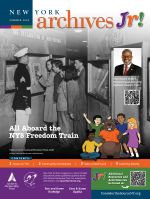
Train of Freedom
By Monica Gray and Jamie Brinkman
As America plans activities around the 250th anniversary of the Declaration of Independence, staff at the New York State Archives have been delving into a twentieth-century celebration of American liberty. Following World War II, a traveling exhibit of foundational documents toured the US between 1947 and 1949. Known as the Freedom Train, the Hollywood-funded display showcased documents and artifacts to promote American heritage and pride. From the Mayflower Compact to the Iwo Jima Flag, the “Spirit of 1776” locomotive brought 133 iconic items to 3.5 million visitors nationwide. The train stopped in Albany for only one day.
This gave Edna L. Jacobsen, head of the Manuscripts and History Section of the New York State Library, an idea. She assembled an exhibition of books and documents in the great rotunda of the New York State Library to show some of the items on the national Freedom Train and highlight New York State’s role in the spread of freedom. The State Library exhibit was featured in several articles in The Knickerbocker News, and the editor suggested making it a traveling exhibit. With support from the New York Society of Newspaper Editors, the State Publishers Association, and the State Legislature, the New York State Freedom Train became a reality.
Both the national and New York Freedom Trains were based on the belief that people needed to study foundational documents firsthand, especially those protecting liberties. In the early Cold War, when communism was seen as a threat to democratic values, organizers promoted enduring democratic values through these documents, which provided an “opportunity for self-development and the building of an enlightened citizenry through education.” As Commissioner of Education Francis T. Spaulding wrote in the introduction to the train’s souvenir book, “Because New York State has pioneered in the cause of freedom, it is especially fitting that it has its own freedom train. The documents on that train serve as timely reminders that our precious liberties are something that people need to fight for.”
In addition to foundational documents, the New York State Freedom Train also contained documents showing the growth of freedom over three centuries of New York State history. All three New York State Constitutions were on exhibit, highlighting the progression of freedom for New Yorkers. Laws ending the enslavement of Indigenous people and African Americans in New York, as well as the introduction of antidiscrimination legislation, demonstrated the expansion of freedom to groups not included in the founding documents.
The Freedom Train included records related to women’s suffrage, labor rights, transportation, and education, documents that tie in to the America250 theme of Unfinished Revolutions, which highlights the ways in which the realization of the goals of the American Revolution remains incomplete. The struggle for the expansion of freedom to all New Yorkers was on display as the exhibit traveled around the state in 1949 and 1950. It proved immensely popular, bringing historical materials to communities statewide in three themed cars: Freedom of Expression, Liberty under Law, and Freedom of Self-Development.
Forty-six of the documents from the train exhibit now reside in the State Archives, as they are official government records, such as laws and minutes from the colonial governments. Thirty-three documents can be found in the State Library's collections, which house many non-governmental records related to New York State history. Ten additional documents were borrowed from repositories across the state.
For the 250th, a virtual version of the New York Freedom Train has been recreated through the Archives Partnership Trust’s Consider the Source NY website. You can browse through digitized copies of the original documents, and we have created transcriptions for those who need a little help reading old handwriting. New York teachers have been busy developing lesson plans to introduce a new generation of New Yorkers to these historical treasures.
This is not the first time the Freedom Train has been revisited by subsequent generations. In 1976, the American Freedom Train traveled to 138 American cities, transporting 500 documents and artifacts to celebrate American history, culture, and achievement. Also in 1976, New York put together the Bicentennial Barge, which sailed the state’s waterways, stopping at thirty-two locations to promote New York’s heritage and culture.
R E L I G I O N
Considered one of the first declarations of religious liberty in America, the Flushing Remonstrance was signed by freeholders of Flushing and Jamaica, Long Island, on December 27, 1657. The Remonstrance protested Governor Peter Stuyvesant’s order forbidding Quakers from holding religious meetings, which violated the religious freedom guaranteed by the Flushing Charter of 1645.
P R E S S A N D S P E E C H
In 1734, printer John Peter Zenger was arrested for printing seditious libel in two issues of his newspaper, the New-York Weekly Journal. One issue asserted that New Yorkers “think, as matters now stand, that their liberties and properties are precarious, and that slavery is now likely to be entailed on them and their posterity.” His arrest was recorded in the minutes of the New York Colonial Council for November 18, 1734. Zenger’s subsequent trial and acquittal were an important step toward the freedom of speech and press afforded by the First Amendment.
R E P R E S E N TAT I V E G O V E R N M E N T
Dongan’s Laws were passed by the first New York Assembly in 1683. This pioneering document, known as the Charter of Liberties and Privileges, granted rights such as trial by jury, freedom of religion, and the right to a representative government. The provision relating to freedom of religion was later included in Section 38 of the New York State Constitution of 1777.
L A B O R R I G H T S
During World War II, minorities seeking jobs in war industries faced discriminatory hiring practices. In 1944, the New York State Temporary Commission on Discrimination, which had been tasked with studying discrimination and making legislative suggestions, reported that the “lack of equal employment opportunity for minority groups is the most economically wasteful and socially dangerous form of discrimination...” The Law Against Discrimination, passed March 12, 1945, aimed to prevent and eliminate discrimination in employment based on race, creed, color, or national origin. It was the first law of its kind in the nation, preceding the Civil Rights Act of 1964 by nearly two decades.
P E R S O N A L L I B E R T Y
During his time as a student at Columbia College, future New York Governor Daniel D. Tompkins wrote an essay on slavery, advocating liberty for all men. Ten years after the American Revolutionary War ended, he wrote that he was “happy for America that she has been successful in her struggle for Liberty, but unhappy that she has not fully completed her design.” Decades later, Governor Tompkins helped complete “her design” with the passage of Chapter 137 of the Laws of 1817, ordering the gradual abolition of slavery and its complete abolition by 1827 in New York State.
S U F F R A G E A N D P R O P E R T Y
The third New York State Constitution, ratified in 1846, abolished all remnants of feudalism and oligarchical government in the state. It also provided all white men twenty-one years or older the right to vote, regardless of whether they owned property. For the first time in the constitutional convention process, delegates for the 1846 Constitutional Convention were chosen by New Yorkers for New Yorkers.
M I L I T A R Y S E C U R I T Y
Part of the Revolutionary War’s “Neutral Ground,” Westchester County was home to many significant battles and was subjected to raids, pillaging, and guerrilla warfare. On January 8, 1776, the Westchester County Committee of Safety wrote to the New York Provincial Committee of its loyal support for the cause, stating that the “Friends of Liberty in this County are willing strenuously to exert themselves to reduce the Enemies to their Country.”
O U R F E D E R A L C O N S T I T U T I O N
New York State became the eleventh state to ratify the federal constitution on July 26, 1788, by a narrow margin of thirty votes to twenty-seven. The ratification, held after a series of contentious debates, took place at a convention in Poughkeepsie. Secretary John McKesson kept a journal of proceedings of the Poughkeepsie Convention, including minutes of resolutions and votes by delegates. The last pages include signatures of George Clinton and other delegates.
M O B I L I T Y
On February 20, 1816, the New York City Common Council wrote to the State Legislature in support of the creation of the Erie Canal. The Council felt that a canal connecting the Great Lakes to the Atlantic Ocean “in the midst of this rising Empire, inspires the mind with the laudable desire, that this generation may at least, lay the foundation of so great a work, the completion of which in the opinion of the Common Council, must be a bond of Union—a source of prosperity and power.” Construction of the Erie Canal started on July 4 the following year in Rome, New York.
E D U C A T I O N
In 1805, DeWitt Clinton and his fellow New Yorkers petitioned the New York State Assembly for access to free education. Clinton argued that while the government was “favorable to the general diffusion of knowledge,” he warned that “the blessings of such a government can be expected to be enjoyed no longer than while its Citizens continue virtuous and while the majority of the People, through the advantage of a proper early education, possess sufficient knowledge to enable them to understand and pursue their best interests.” That same year, Chapter 66 of the Laws of 1805 was passed, authorizing the sale of 500,000 acres of unappropriated State land to create a fund to support public schools.
S C I E N C E
The Society for Promotion of Agriculture, Arts and Manufactures, incorporated in 1793 by Chapter 59 of the Laws of 1793, was the first agricultural society in New York State and the fifth in the country. Its goal was to promote new and experimental scientific procedures to improve agriculture, horticulture, and household arts across the state. The Society evolved into the still-active New York State Agricultural Society.
S TAT E S E R V I C E
New York State’s Civil Service Law was passed on May 4, 1883, making it the first state in the nation to have a law promoting a civil service system within the government. The law continued to receive support, as evidenced by a 1931 response from Governor Franklin D. Roosevelt, who noted that holding open competitive examinations “makes for better efficiency and effort within the service.”
In 2026, a national Freedom Plane will be carrying documents from the National Archives in Washington, DC, to eight cities across the nation. The traveling federal exhibition, titled Documents That Forged a Nation, will include the 1783 Treaty of Paris, signed by John Adams, John Jay, and Benjamin Franklin, which formally ended the War of Independence and recognized the United States as a sovereign nation.
The New York State Office of Parks, Recreation and Historic Preservation’s Revisit the Revolution Traveling Exhibition will also be traveling the state with objects related to New York and the Revolutionary War, including a pendant brooch containing a lock of George Washington’s hair from the Schuyler Mansion State Historic Site.
About the Authors
Monica Gray is director of archival services for the New York State Archives.
Jamie Brinkman is a researcher services supervisor for the New York State Archives.
For More Resources
Freedom Train Documents at ConsidertheSourceNY.org
Revolutionary New York 250 | Years of Social Change
Edited by Bruce W. Dearstyne
Revolutionary New York celebrates the 250th anniversary of the American Revolution and the many historical changes that have occurred since, as reflected through the history of the state.

Cultural Education Center
Suite 9C49
Albany, NY 12230
Phone: (518) 473-7091
Email: aptrust@nysed.gov